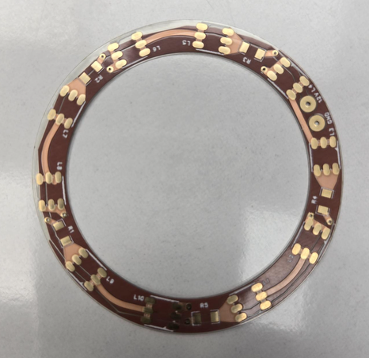
Flexible PCBs, commonly referred to as Flex PCBs, are printed circuit boards designed to be bent, folded, or twisted without damaging the circuitry. They provide electrical connections in applications where space constraints, complex shapes, or dynamic movements exist. Unlike traditional rigid PCBs, flex PCBs use flexible substrates such as polyimide (PI) or PET (polyethylene terephthalate), which allow them to conform to unusual geometries.
Construction of Flex PCBs
A typical flex PCB consists of multiple layers:
• Substrate: The flexible base material, usually polyimide, which provides mechanical support.
• Copper Traces: Conductive pathways etched or printed on the substrate to carry electrical signals.
• Adhesive: Used to bond copper layers to the substrate in some types of flex PCBs (adhesive vs adhesive-less types).
• Protective Coverlay: Replaces the rigid solder mask; it protects the circuitry and insulates the copper traces.
• Stiffeners (Optional): Rigid materials added in specific areas to provide mechanical support for component mounting.
Types of Flex PCBs
• Single-Sided Flex PCB: Copper traces on one side of the flexible substrate; simple and cost-effective.
• Double-Sided Flex PCB: Copper traces on both sides with vias to connect layers; supports more complex circuits.
• Multi-Layer Flex PCB: Multiple layers of copper and insulating material; used in high-density applications like smartphones and medical devices.
• Rigid-Flex PCB: Combines flexible and rigid sections; offers reliability while allowing flexibility.
Advantages of Flex PCBs
• Space-saving: Can fit into compact and irregular spaces
• Weight reduction: Lighter than rigid PCBs
• Durability: Withstands vibrations, shocks, and repeated bending
• Reduced interconnects: Eliminates many connectors and cables
• Improved signal integrity: Shorter paths reduce signal loss and noise
Applications of Flex PCBs
• Consumer Electronics: Smartphones, tablets, laptops, cameras
• Medical Devices: Pacemakers, hearing aids, imaging equipment
• Automotive: Airbags, sensors, infotainment systems, LED lighting
• Aerospace & Defense: Satellites, drones, military electronics
• Industrial Equipment: Robotics, sensors, compact control boards