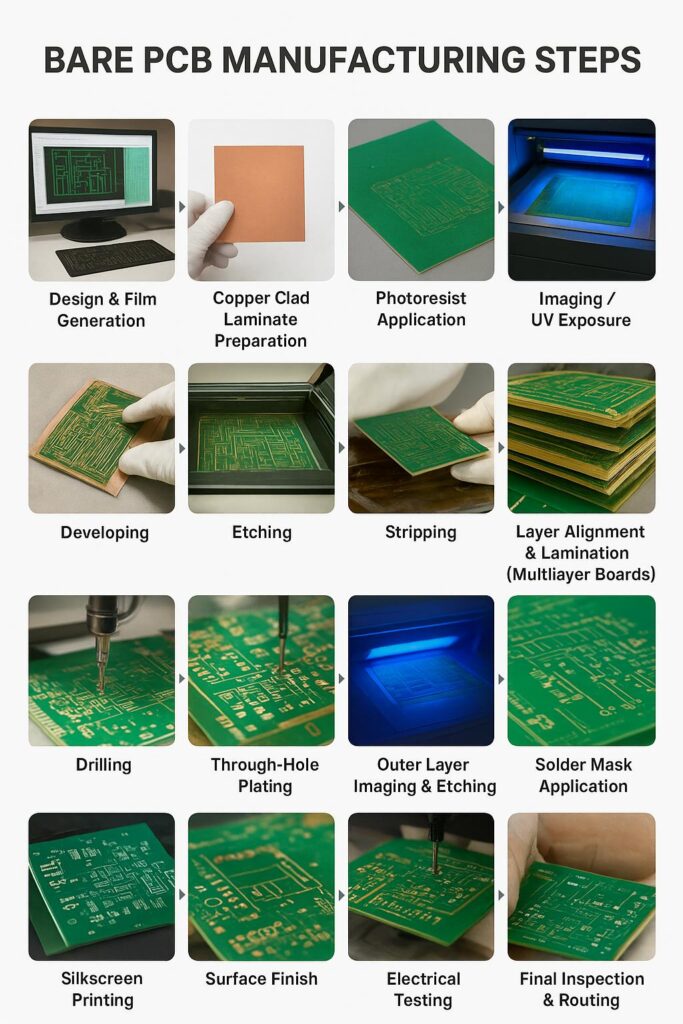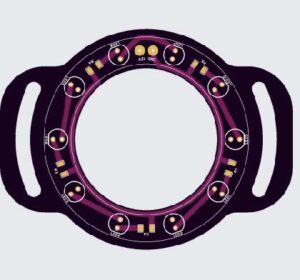
PCB
PCB (Printed Circuit Board)
A PCB (Printed Circuit Board) is the backbone of almost all modern electronic devices. It is a flat board made of an insulating material (such as fiberglass epoxy, called FR4) with a thin layer of conductive copper laminated on one or both sides.
Instead of using loose wires to connect components, a PCB uses copper tracks (traces) that are etched onto the board to create electrical connections between electronic components like resistors, capacitors, ICs, and connectors.
PCB Materials Comparison
FR-4 (Fiberglass Epoxy)
Pros:
- Low cost, widely available
- Good mechanical strength
- Flame resistant
Cons:
- Limited high-frequency performance
- Moderate thermal stability
Typical Applications: Consumer electronics, computers, industrial control
CEM-1 / CEM-3 (Composite Epoxy)
Pros:
- Cheaper than FR-4
- Easy to punch-process
- Good electrical insulation
Cons:
- Lower mechanical strength
- Less heat resistance
Typical Applications: Low-cost appliances, calculators, simple electronics
Polyimide
Pros:
- High thermal stability (Tg > 250°C)
- Flexible and durable
- Resistant to chemicals
Cons:
- More expensive than FR-4
- Higher moisture absorption
Typical Applications: Aerospace, automotive, flexible PCBs, medical devices
PTFE (Teflon)
Pros:
- Excellent dielectric properties
- Very low signal loss
- High-frequency suitability
Cons:
- Expensive
- Difficult to process (requires special handling)
Typical Applications: RF circuits, microwave boards, radar, 5G systems
Metal-Core (Aluminum, Copper)
Pros:
- Superior heat dissipation
- Good mechanical strength
- High current capacity
Cons:
- Heavier and less flexible
- Higher cost than FR-4
Typical Applications: LED lighting, power converters, automotive electronics
Flexible (Polyimide, Polyester film)
Pros:
- Can bend/fold
- Lightweight and space-saving
- High reliability in moving parts
Cons:
- Limited layer count
- More expensive manufacturing
Typical Applications: Smartphones, wearables, medical implants, cameras
Ceramic (Alumina, Aluminum Nitride)
Pros:
- Excellent heat conductivity
- Stable dielectric properties
- High durability
Cons:
- Very expensive
- Brittle and hard to manufacture
Typical Applications: Power electronics, military, aerospace, high-frequency devices